A Beginner's Guide to Keys, Chords and Lessons
A Beginner's Guide to Keys, Chords and Lessons
Keyboard and piano are among the most popular instruments in the world, and for good reason. They are visual, logical, and versatile. You can play a melody, chords, and a bass line all at once, and the layout of the keys makes music theory easier to see and understand. Whether you dream of playing classical sonatas, pop songs, or film music, this is a great place to begin. In our music class, we help students of every age build skill and confidence at the keys.
This guide covers the differences between the two instruments, how to sit and place your hands, the basics of notes, scales, and chords, and how to practice effectively.
Why Study Keyboard and Piano?
The benefits go well beyond the music itself:
- A clear view of music theory: the keys show scales, intervals, and chords in a visual layout.
- Coordination: using both hands independently strengthens the brain and the body.
- Focus and patience: regular practice builds discipline.
- Creative freedom: you can accompany singers, write songs, and compose.
- A foundation for other instruments: reading, rhythm, and harmony skills carry across every kind of music.
Keyboard vs Piano: What Is the Difference?
Many beginners ask about piano vs keyboard, and the answer matters when you are choosing what to buy or practice on.
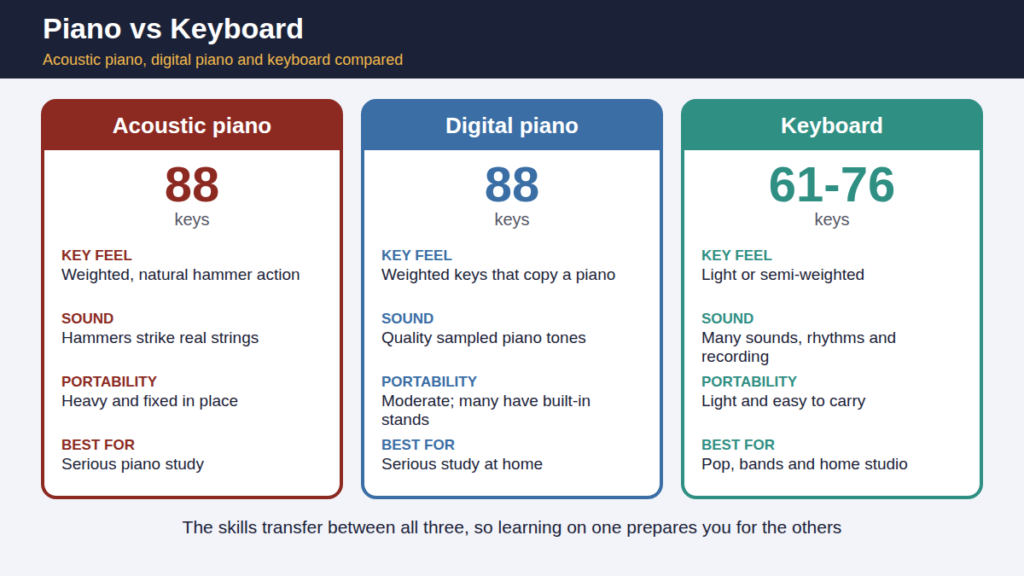
- Acoustic piano: produces sound when hammers strike strings inside the body. It has 88 keys and a rich, natural tone that responds to how softly or firmly you play. Upright and grand pianos are the two main types.
- Digital piano: an electronic instrument designed to feel and sound like an acoustic piano. It usually has 88 weighted keys, quality piano samples, and often built-in pedals.
- Keyboard: a lighter, more portable electronic instrument, typically with 61 or 76 keys. It offers many sounds, rhythms, and recording features, which makes it popular for pop, band, and home studio use.
The skills transfer between all three, so learning on one prepares you for the others. If your goal is serious piano study, a digital piano or acoustic piano is the better long-term choice. If you want variety and portability, a keyboard is a fun and affordable start.
Understanding Weighted Keys and Touch
Weighted keys are designed to mimic the resistance of an acoustic piano, where each key is slightly heavy and returns with a natural feel. This helps you develop finger strength and control over volume, known as dynamics. Unweighted or semi-weighted keys are lighter and easier to press, which suits some styles but does not build the same technique.
Many teachers recommend weighted keys for anyone who plans to continue with piano, because moving later from light keys to a heavy action can feel frustrating. If you are not sure, ask your instructor before buying, and consider renting or practicing at a studio first.
Getting Started: Posture and Hand Position
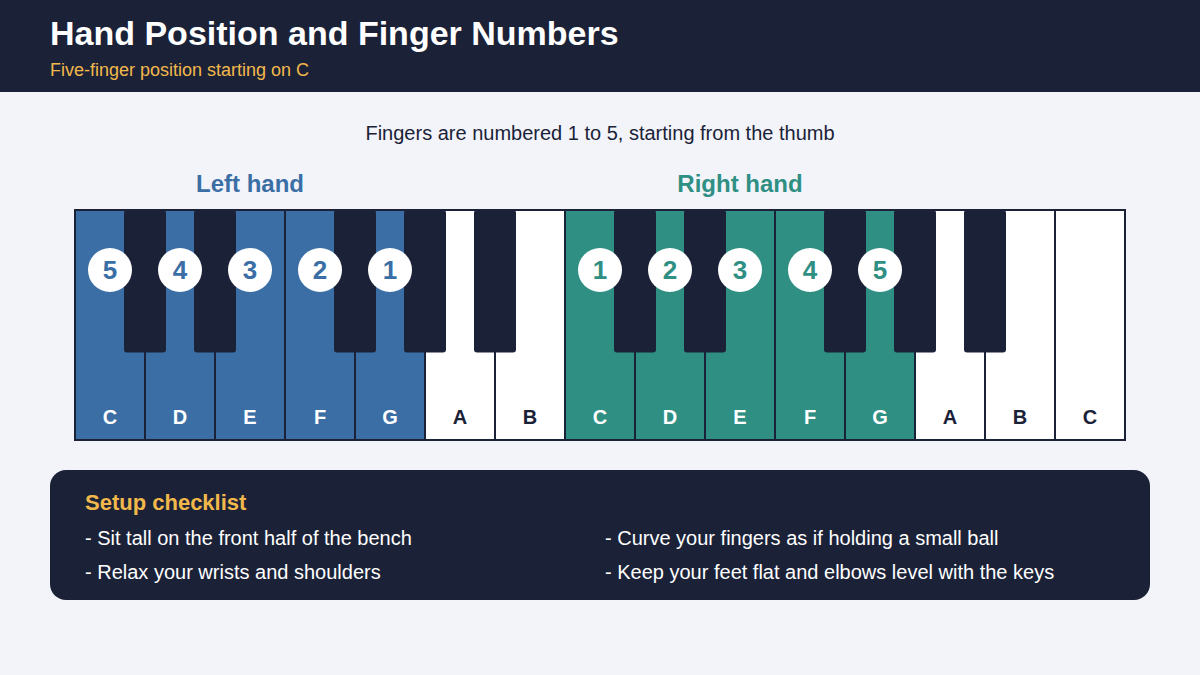
Good habits formed early prevent tension and injury later. Before you play, check your setup:
- Sit tall. Sit toward the front half of the bench with a straight, relaxed back.
- Keep your elbows level with the keys. Adjust the seat height if needed.
- Plant your feet. Rest them flat on the floor, or on a footstool for younger students.
- Curve your fingers. Imagine holding a small ball so your fingertips land on the keys, with the thumb relaxed at the side.
- Relax your wrists and shoulders. Tension is the enemy of smooth playing.
Correct hand position helps your fingers move quickly and evenly. Fingers are numbered one to five, starting from the thumb, and this numbering appears in most beginner sheet music.
The Notes on the Piano
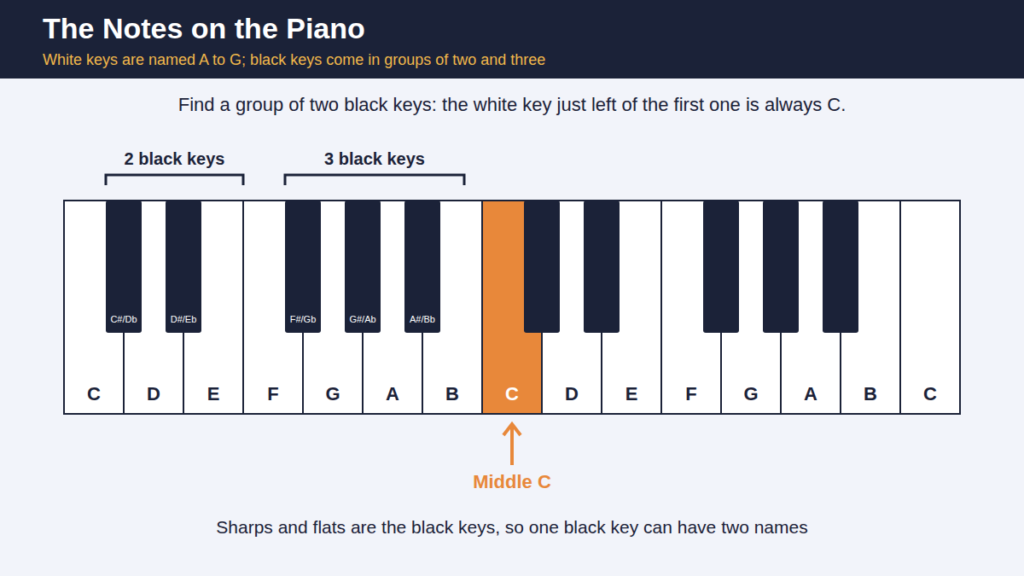
The keyboard looks complicated, but it follows a simple repeating pattern. The black keys come in groups of two and three, and the white keys are named with the letters A to G. Find a group of two black keys, and the white key just to the left of the first one is always C. From there you can locate every other note.
Learning the notes on the piano takes only a short time with this landmark system. Middle C, near the center of the keyboard, is the starting point for most beginner pieces. Sharps and flats are the black keys, so a single black key can have two names depending on the music, such as C sharp or D flat.
How to Read Sheet Music
Knowing how to read sheet music opens up a vast library of songs. Piano music uses two staves joined together:
- The treble clef (top staff) is usually played by the right hand and covers higher notes.
- The bass clef (bottom staff) is usually played by the left hand and covers lower notes.
Notes sit on the lines and spaces of each staff. Their shapes show how long to hold them, and the time signature tells you how many beats are in each bar. Beginners often learn by starting with five-finger positions, where each finger rests over one note, so there is no need to move around the keyboard while learning to read.
Regular sight reading practice, which means playing a new piece without preparing it first, builds fluency quickly. Even two minutes a day on easy material makes a noticeable difference.
The Role of the Pedals
An acoustic piano has three pedals, though beginners mainly use one. The sustain pedal, on the right, lifts the dampers from the strings so notes continue to ring after you release the keys. It adds warmth and flow, especially in slow or romantic pieces. Use it sparingly at first and change it cleanly with each chord, or the sound will blur.
Many digital pianos include a sustain pedal or a port to connect one. A keyboard may have a switch-style pedal, which works in the same way.
Scales and Finger Technique
Piano scales are the foundation of technique. They train your fingers to move evenly, teach you the structure of keys, and prepare you for playing real pieces. Begin with the C major scale, which uses only white keys. Play one octave with each hand, then two, keeping the rhythm steady and the tone even.
The key skill is the thumb tuck: after playing three fingers in a row, the thumb passes under the hand to continue the scale smoothly. Practice slowly and watch for tension in the wrist. Once C major feels comfortable, move on to G major, F major, and the minor scales.
Learning Piano Chords
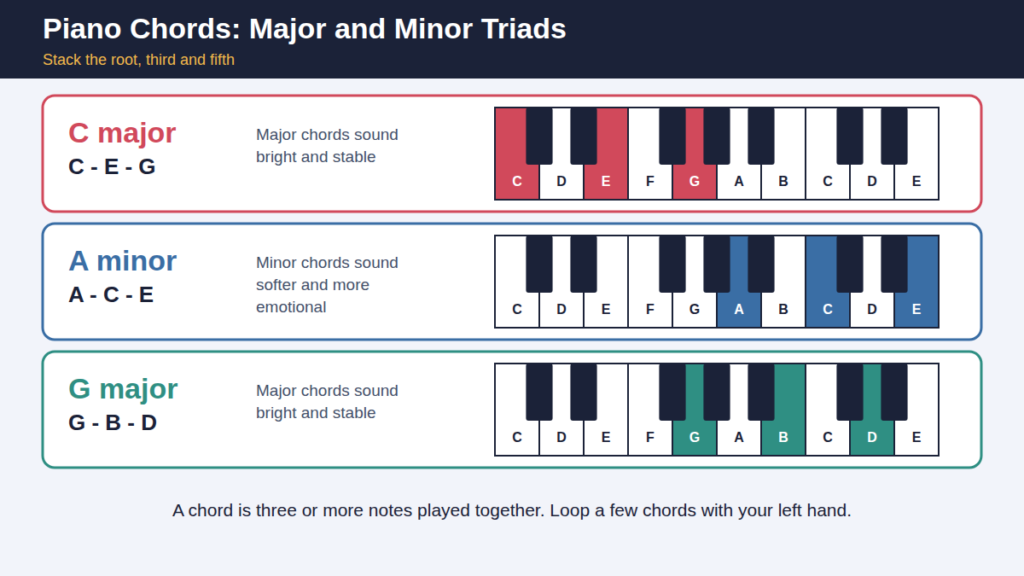
Melody is only part of the picture. Piano chords let you accompany yourself or others and play thousands of songs. A chord is three or more notes played together, and the simplest type is the triad:
- Major chords sound bright and stable, such as C major (C, E, G).
- Minor chords sound softer and more emotional, such as A minor (A, C, E).
Start with a handful of common chords, then learn to switch between them smoothly. A popular beginner exercise is to play a four-chord loop with the left hand while the right hand plays a simple melody. This approach is the foundation of pop, rock, and singer-songwriter music, and it teaches the coordination between hands that every pianist needs.
Building a Piano Practice Routine
A consistent piano practice routine is more valuable than long, occasional sessions. Try this 25-minute plan:
- Warm up (3 minutes): play a few scales or five-finger patterns, slowly.
- Technique (5 minutes): practice an exercise or the scale of the week.
- Reading (5 minutes): sight read a short, easy piece.
- Repertoire (10 minutes): work on your current piece in small sections, hands separately before hands together.
- Play for fun (2 minutes): finish with something you enjoy.
Use a metronome to keep time, and slow down whenever you make mistakes. Speed should grow out of accuracy. Recording yourself now and then helps you notice progress and problem areas.
Styles You Can Explore
One of the joys of keyboard and piano is the range of music available. Students in our classes explore:
- Classical: structure, expressive touch, and a strong technical base
- Pop and rock: chords, rhythm, and accompaniment
- Jazz and blues: improvisation and rich harmony
- Film and game music: emotional themes and modern sounds
- Devotional and Indian styles: melodic ornamentation and accompaniment on the harmonium or keyboard
Trying different styles keeps practice fresh and helps you find your own musical voice.
Piano Lessons and Keyboard Lessons
You can learn a lot from videos and apps, but they cannot see your hands, posture, or timing. A teacher notices small problems early, tailors the pace to you, and keeps you motivated. Our piano lessons and keyboard lessons are structured, friendly, and built around your goals. In our beginner piano lessons, students learn to:
- Sit and place their hands correctly
- Find and name notes across the keyboard
- Read sheet music in both clefs
- Play scales, chords, and simple pieces
- Use dynamics, phrasing, and the sustain pedal
- Perform for classmates in a supportive setting
Lessons suit children, teenagers, and adults, and no previous experience is required. We can also advise you on choosing an instrument for home practice.