A Complete Beginner's Guide to Rhythm
Drums and percussion are the heartbeat of music. Every genre, from rock, jazz, and pop to classical, folk, and film scores, depends on rhythm, and percussion is what gives that rhythm its shape and energy. If you’ve ever tapped a table along to a song or drummed on a steering wheel, you already have the instinct. In our music class, we help students turn that instinct into real, confident skill.
This guide covers everything a beginner needs to know: what percussion is, where it came from, the main types of drums, how a drum kit works, the techniques you’ll learn first, and how to get started.
What Are Percussion Instruments?
Percussion instruments produce sound when they are struck, shaken, scraped, or rubbed. This is the largest and most varied family of instruments, and the term covers everything from a massive concert bass drum to a tiny triangle. Percussion is usually divided into two groups:
- Pitched percussion: instruments that play specific notes and can carry a melody, such as the xylophone, marimba, vibraphone, glockenspiel, and timpani.
- Unpitched percussion: instruments that provide rhythm, accents, and texture without a definite pitch, such as the snare drum, cymbals, tambourine, woodblock, and triangle.
Some instruments blur the line. Timpani, for example, are drums that can be tuned to exact pitches, which is why you’ll see them in both categories.
A Short History of Drums and Percussion
Percussion is the oldest instrument family in human history. Long before written music, people used hollow logs, stretched animal skins, stones, and bones to make rhythm. Drums were used to send messages across long distances, to accompany ceremonies and dances, and to bring communities together.
Over the centuries, drums traveled and evolved. Military drums shaped European marching traditions. Frame drums and hand drums spread across the Middle East, Africa, and Asia. In the 19th and early 20th centuries, drummers in New Orleans combined a bass drum, snare, and cymbals into a single setup operated by one player. That arrangement became the modern drum kit, which went on to define jazz, rock, funk, and pop.
Types of Drums
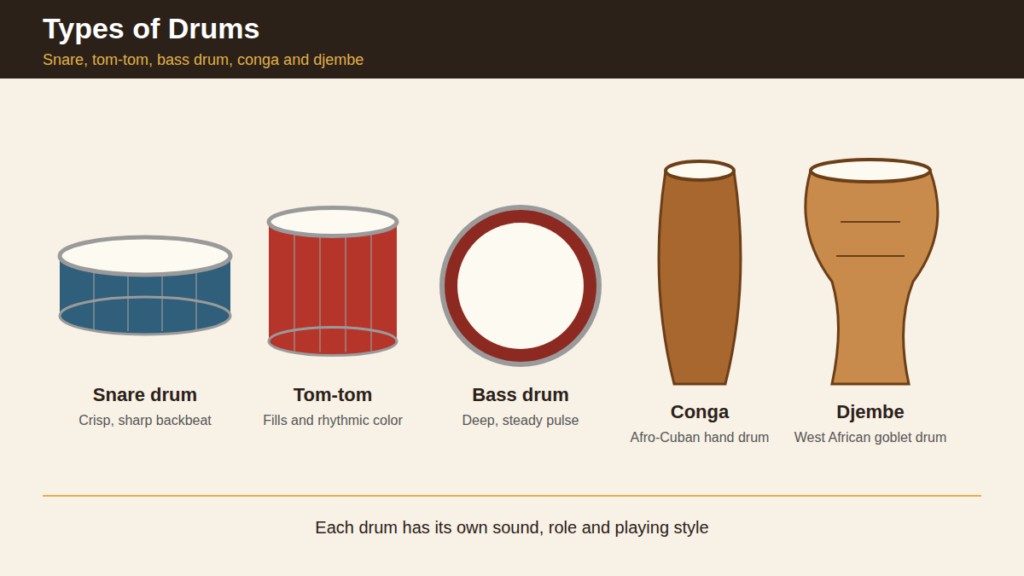
Knowing the types of drums is the first step in choosing the instrument that suits you. Here are the most common ones.
- Snare drum: A crisp, sharp-sounding drum with metal wires (called snares) stretched across the bottom head. The snare drum is the backbone of marching bands, an orchestral staple, and the “crack” on the backbeat in rock and pop. It’s also the instrument on which most beginners learn their first rudiments.
- Bass drum: A large, deep drum that sets the pulse of the music. In a drum kit it’s played with a foot pedal, while in orchestras and marching bands it’s played with a mallet.
- Tom-toms: Drums of different sizes and pitches, used for fills, transitions, and rhythmic color. Higher toms sound bright and punchy, while floor toms sound deep and rich.
- Congas: Tall, barrel-shaped drums from Afro-Cuban music, usually played in pairs or sets of three with the hands.
- Bongos: A pair of small, joined hand drums, played between the knees, with a bright, lively tone.
- Djembe: A goblet-shaped West African drum with a wide range of sounds, from deep bass tones to sharp slaps, all played with bare hands.
- Timpani: Large copper kettle drums that can be tuned to specific notes with a pedal. They are a core part of the orchestra.
- Cajón: A box-shaped drum that the player sits on and strikes with the hands. It’s popular in flamenco, acoustic, and folk music.
Each drum has its own sound, role, and playing style, so it’s worth trying a few before deciding where to focus.
The Drum Kit Explained
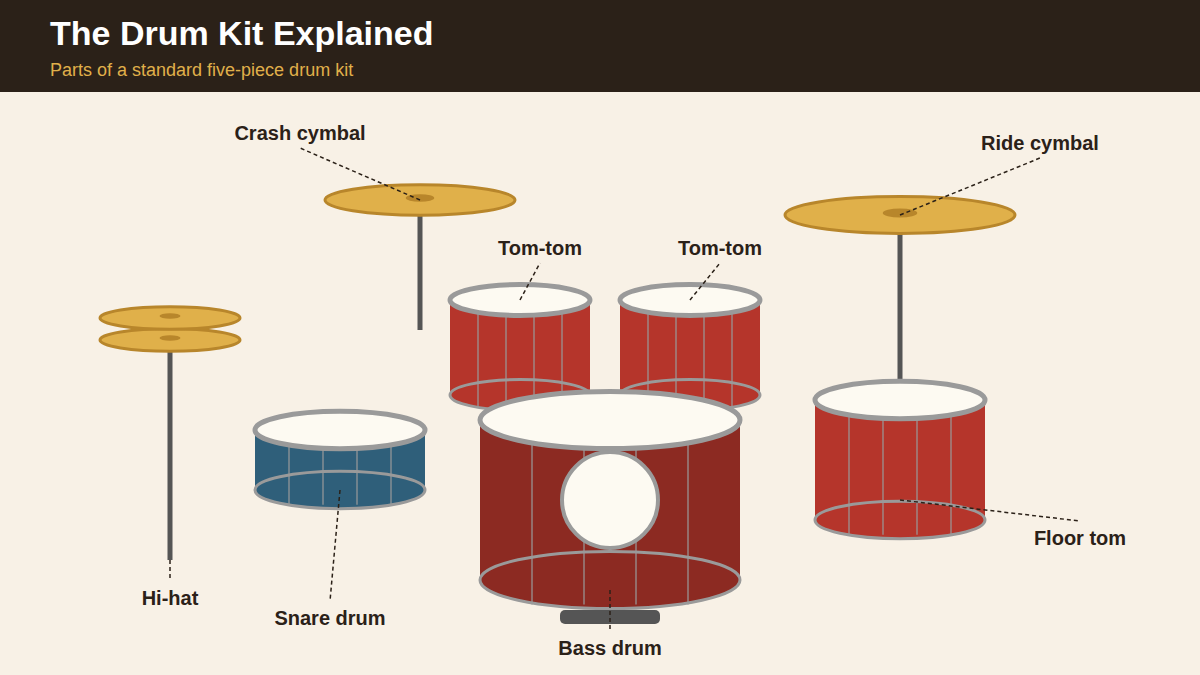
The drum kit (also called a drum set) combines several drums and cymbals so that one player can perform them all. A standard five-piece setup includes:
- A bass drum, played with the right foot
- A snare drum, placed between the knees
- Two mounted toms and one floor tom
- A hi-hat, a pair of cymbals on a stand, opened and closed with the left foot
- A crash cymbal for accents and a ride cymbal for steady patterns
The hands hold drumsticks, while the feet operate the bass drum and hi-hat pedals. Because all four limbs play different parts at once, coordination is the main challenge of the kit, and also its biggest reward. Most beginners start with a simple pattern of bass drum on beats one and three, snare on two and four, and hi-hat eighth notes, which is the foundation of countless songs
Hand Percussion and World Rhythms
Hand percussion is an excellent starting point for many students. It needs little equipment, it’s easy to carry, and it lets you feel rhythm directly through your hands. Popular choices include:
- Shakers and egg shakers
- Claves and woodblocks
- Tambourines
- Cajón and frame drums
- Congas, bongos, and djembe
Hand percussion also opens the door to the rhythmic traditions of Africa, Latin America, India, and the Middle East. Learning a samba groove, a clave pattern, or a West African ensemble rhythm teaches you to listen, interlock with other players, and think about rhythm in new ways. These skills transfer directly to the drum kit and to every other instrument.
Percussion in Orchestras and Marching Bands
Orchestral percussion includes timpani, snare drum, bass drum, cymbals, triangle, and mallet instruments such as the xylophone and glockenspiel. Orchestral percussionists often play many instruments in a single piece, counting long rests and then delivering a perfectly timed crash or roll. It demands patience, concentration, and a good ear.
Marching percussion is the engine of parades and field shows. A typical drumline features snare drums, tenor drums, bass drums, and cymbals, with a “front ensemble” of pitched instruments such as marimbas and vibraphones. Marching percussion is physical, precise, and highly team-oriented, since a single out-of-sync player is easy to hear.
Both settings are excellent training. They build reading skills, discipline, dynamics control, and the ability to blend with a group.
Essential Drumming Techniques
Good drumming techniques start with the fundamentals. Developing them early prevents bad habits, builds speed naturally, and helps avoid tension and injury.
- Grip: Hold the sticks loosely, pinching them between the thumb and the first finger, with the other fingers wrapped gently around. The stick should be able to bounce freely off the drum.
- Posture: Sit upright with your back straight and your throne height set so your thighs are roughly level with the floor. Keep your shoulders, arms, and wrists relaxed.
- Stroke control: Practice full strokes, tap strokes, and accents. Aim for clear, even strokes at every volume, from whisper-quiet to full power.
- Timing: Practice with a metronome from day one. A steady pulse is the most valuable skill a drummer can have.
- Dynamics: Learn to play softly as well as loudly. Great drummers shape the music through volume changes.
Learning Drum Rudiments
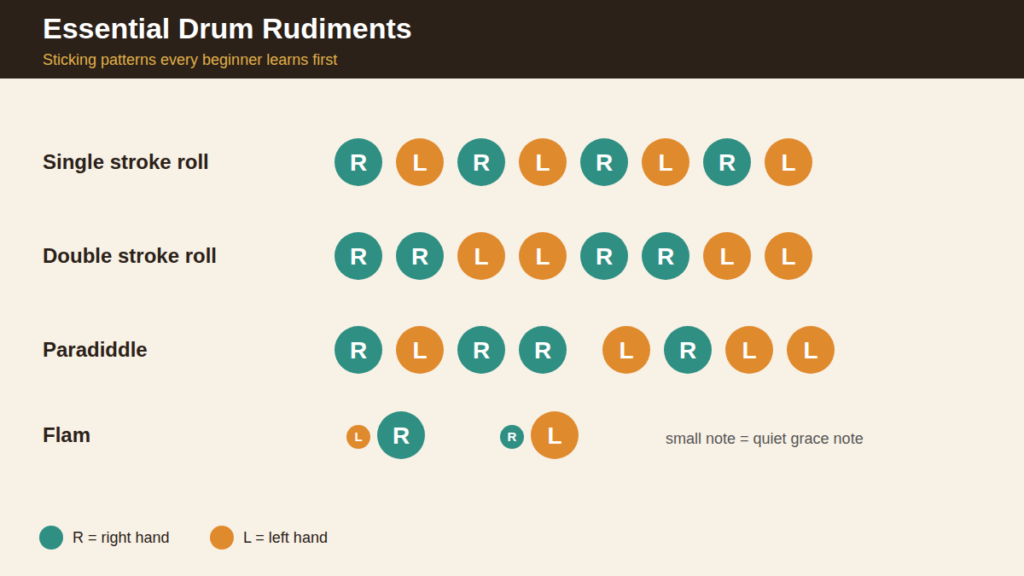
Once the basics feel comfortable, students move on to drum rudiments. These are standard sticking patterns that form the vocabulary of drumming, in the same way that scales form the foundation for other instruments. The first rudiments every player learns are:
- Single stroke roll: Alternating hands evenly (R L R L).
- Double stroke roll: Two strokes per hand (R R L L).
- Paradiddle: A four-note pattern (R L R R, L R L L) that is the building block of countless fills and grooves.
- Flam: A quiet “grace note” played just before a main note, giving a fuller sound.
- Buzz roll: A smooth, sustained sound created by letting the stick bounce multiple times per stroke.
Rudiments build hand control, speed, and coordination, and they can be applied around the drum kit to create original fills and rhythms.
How to Learn Drums
If you want to learn drums, you don’t need an expensive setup. Many successful drummers start with just a few simple items. Here’s a beginner’s gear checklist:
- A practice pad: A quiet, compact surface for working on technique anywhere.
- A pair of drumsticks: A standard 5A size is a good all-purpose choice for most beginners.
- A metronome: A physical one or a free app, for building steady time.
- Earplugs or headphones: To protect your hearing, especially around a full kit.
- Access to a drum kit: At your music class, a studio, or at home once you’re ready.
Beyond equipment, a few habits make the biggest difference:
- Practice little and often. Fifteen to twenty minutes a day beats a single two-hour session each week.
- Start slowly. Speed comes from accuracy, not from rushing.
- Listen actively. Pay attention to drummers in different styles and try to copy the grooves you hear.
- Play along with music. It builds timing, feel, and confidence.
- Record yourself. Listening back is one of the fastest ways to spot improvements.
Drum Lessons for Beginners
Teaching yourself is possible, but a good teacher saves time, corrects bad habits early, and keeps you motivated. Our drum lessons and beginner drum lessons are designed to be fun, practical, and structured around your goals. Students learn to:
- Read basic rhythm notation and count time
- Hold the sticks and play with good technique
- Play simple beats on the practice pad and the drum kit
- Work through essential drum rudiments
- Keep steady time with a metronome
- Explore hand percussion and world rhythms
- Perform with classmates in ensemble settings
You’ll go from clapping a rhythm to playing a complete groove, with an instructor guiding you at every step. Lessons are suitable for children, teenagers, and adults, and no previous musical experience is needed.
Why Study Drums and Percussion?
Learning percussion offers benefits well beyond the music itself:
- Coordination: Playing different rhythms with each hand and foot develops motor skills.
- Focus and discipline: Regular practice builds concentration and patience.
- Listening skills: Percussionists learn to hear how every part fits together.
- Confidence and stress relief: Playing drums is a physical, expressive outlet, and performing builds self-belief.
- A strong musical foundation: Rhythm is the basis of all music, so these skills carry over to every other instrument.
Whether you want to join a band, play in an orchestra, march in a drumline, or simply enjoy making music, percussion is a great place to start.